The Lost Sectors
The Red Marsh
While the Lost Sectors have been called many things, there is one thing most can agree on.
Whatever plate they occupy, things have gone.. a little strange. The area has seen multiple psychic, biological and magical disasters. It has weathered multiple full Quarantines, invasions by the Unmade and other undesirable tenants. This slice of reality, once broken, has never quite healed properly.
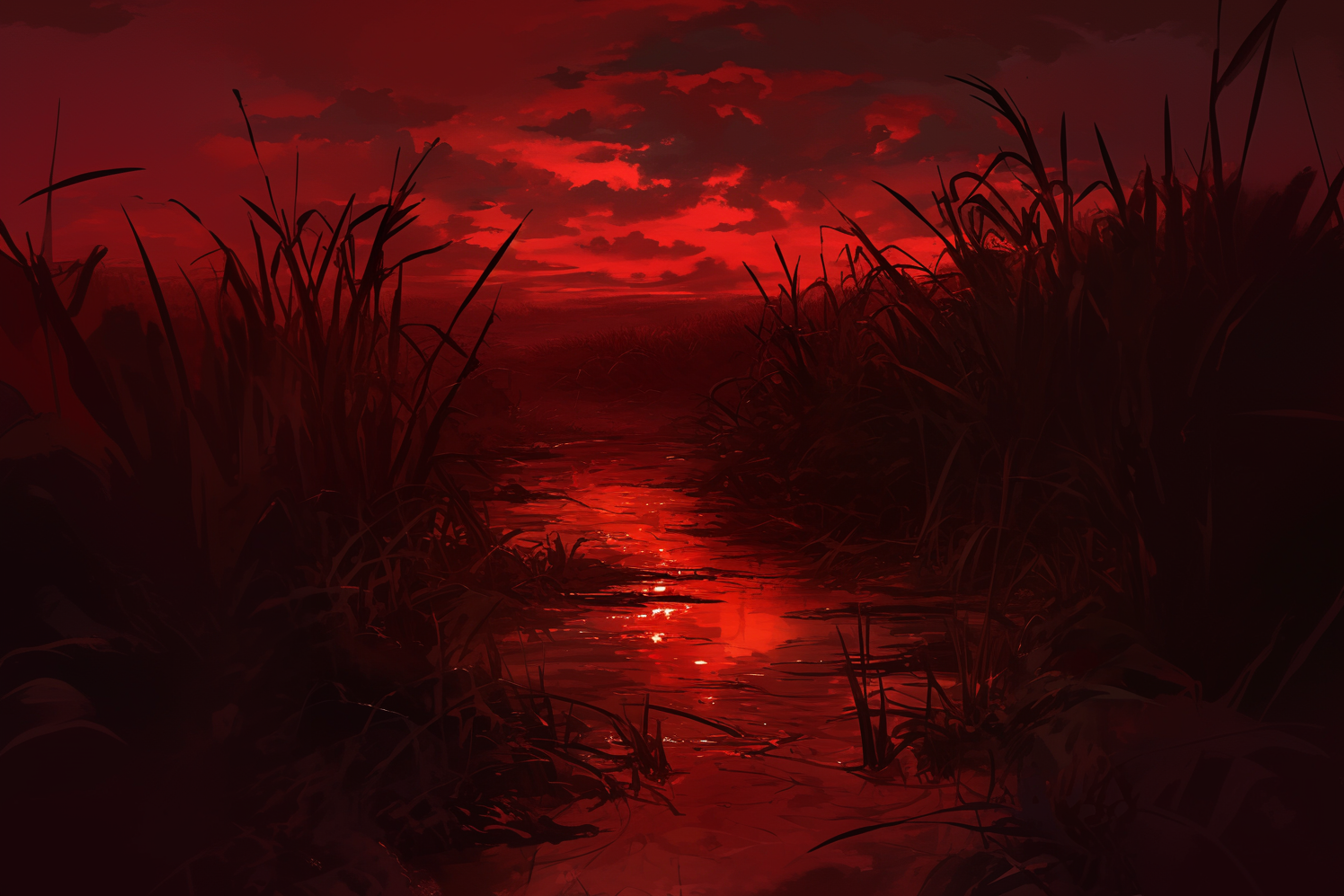
A dark, red sunset in the Red Marsh. Or maybe a sunrise? Hard to tell. Don't lose your way...
The Red Marsh, the outlying edge of the Lost Sectors, sits with Aurborea on the Outer Shell. It blooms throughout overgrown ruins and the trappings of civilizations long passed from memory. Miracles grow here, in the soil of the Red Marsh. Potent magical and alchemical reagents can be found easily enough, in plants as well as the flesh of beasts and whatever can be scavenged from the surrounding ruins. Yet despite this, most Hunters know to turn back when the animal and plant noises fade. When nothing remains of the ambient noise, you have reached The Quiet, a phenomenon that extends throughout the marshland for many miles.
Speech feels like an imposition here. The Quiet drinks up all sound and there is a distinct flavor to the air, like some invisible yet indifferent presence is listening. There are boardwalks and marked footpaths through the Red Marsh, but most people travel by boat, under the witchlights that dispel darkness and illusion.
They do so because the marsh is always changing. It slowly grows or shrinks depending on unseen patterns, and mapping it tends to be an exercise in frustration. The locals seem to know their way around, but not only does the terrain shift, but stories abound of ruined complexes swapping places or strange buildings without visible entry appearing where there was nothing but swampgrass. The boardwalks for the most part remain safe, so long as certain rules are followed. Chief among them, a warning -- Once you have stepped onto a path, do not leave it. Not for any reason.
There is ample food in the marshes, including a species of giant poisonous snake hunted obsessively by the locals, but Gapspace mutations run even more rampant here than anywhere else, often requiring several steps of processing or preparation to remove impurities. Clean water is also difficult to come by, making self-reliance, boiling and other outside resources and knowledge vital for exploration. There are outposts, fishing communities and hunting lodges inside the marsh, but just as many whispered stories about them.
The people who make their homes in the Red Marsh tend to be highly skilled, secretive and tightly-knit. Outside of a few larger holdouts, they mostly consist of small fishing or hunting communities of a few families. Death is less common than disappearance, and there is much of both in these lands. The marsh is a haven for ambush predators, haunting whispers, hallucinogenic plants and things that use illusions or shapeshifting tactics to secure their meals.
So of course there would be rumors. It's simply a matter of which ones to follow.
Culture
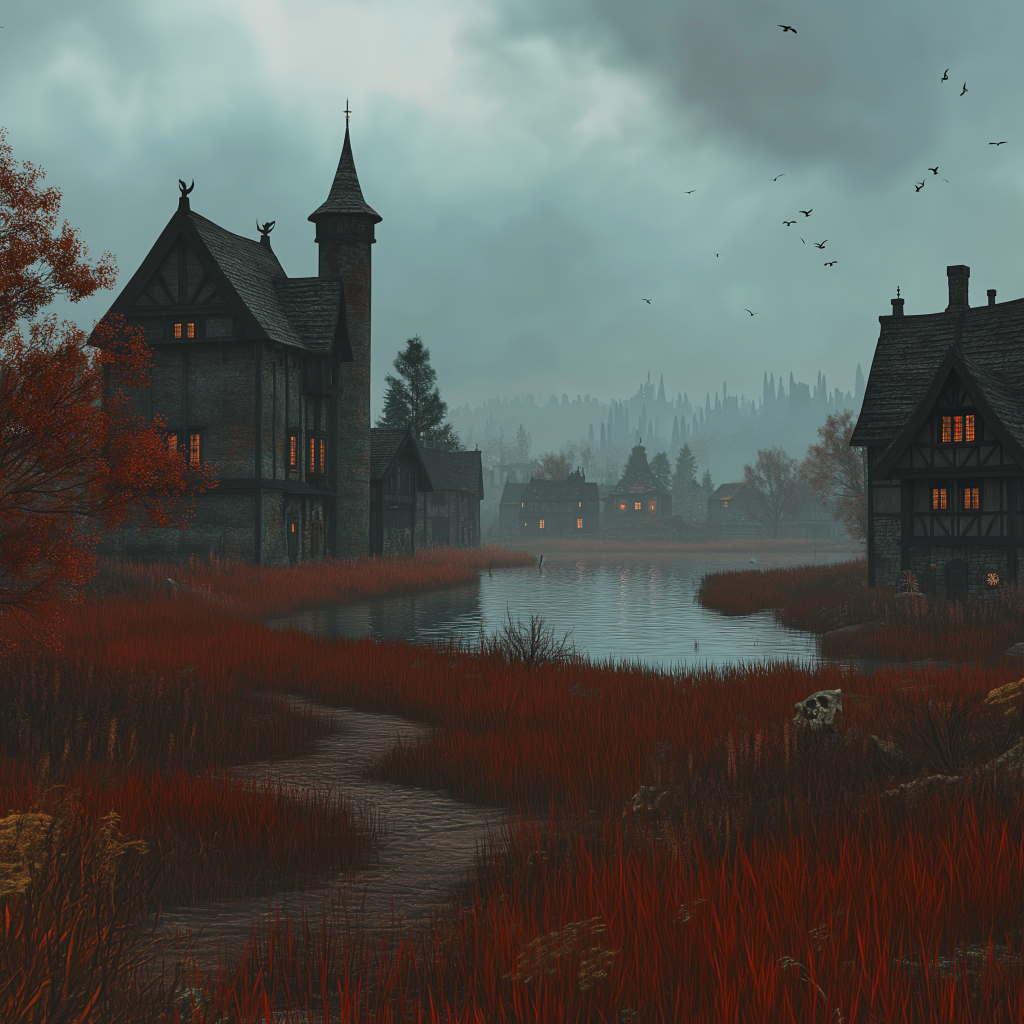
A remote homestead in the Red Marsh. Just as dangerous as elsewhere in Aurborea, but for different reasons...
The people who make their homes in reach of the Quiet, where everything you see and hear could be a lie, tend to know the value of a freely given truth. Sometimes it is the only weapon they have. They know how difficult it is to trust others and do so anyway. They remain firm but polite in any but the most aggravating circumstances. There is even an element of fear behind their calm, friendly banter and smiles, as though every interaction were a secret test of their hospitality.
Anyone can create a home here if they wish, though the locals strongly recommend finding or bargaining for a sapling of a silverwood tree from another outpost before doing so. An alchemist would find nothing special about the plant, but it seems a tradition few are willing to ignore.
Each homestead is centered around one of these large silver trees, and survives by following a series of customs and rituals that have developed in the treacherous environment. They offer shelter to anyone who comes by their raised farms or walled compounds, but Travelers will often find they are housed outside the main area in a boathouse, guest room or other isolated sidebuilding until they are better trusted.
Some of the rituals are quaint, such as telling a story in payment for your stay, or lighting a candle at the base of the silver tree. And.. sometimes they are much stranger. Never look into a pool of still water. Never look back at a shelter you just left, and never trust someone who lets you past the second gate at night, or offers food and shelter in exchange for vague or undescribed favors.
The bones of monsters, especially serpents, are carved and painted with runes. Some are kept like protective talisman while others are used as dice, with little seeming difference between the two. Monsters are often dressed in the field, hauled by boats or floating rafts made of dark, spongy wood woven with sharp thorn plants whose sap repels carrion feeders.
Points of Interest
Aithreachas, the Tree of Regrets: There are few locations, remaining anchors to reality, that are not prone to shift within the boundaries of the Quiet. Aithreachas is one of the largest and most well known. A sprawling silver mangrove tree the size of a stately mansion, covered in runes and ancient scars. The tree is the site of many common gatherings, festivals and pilgrimages, as predators tend to avoid the area even at night. The tree is ringed with countless tiny shrines, fragments of story and song carved into stones sticking out from pools smothered in swampgrass and duckweed. Memories are written on specially treated parchment by those wanting to relieve themselves of their regrets, then left to hang against the trunk or the countless weeping branches. The writer faces their regret and leaves it behind. When the paper eventually rots away, it's already blank.
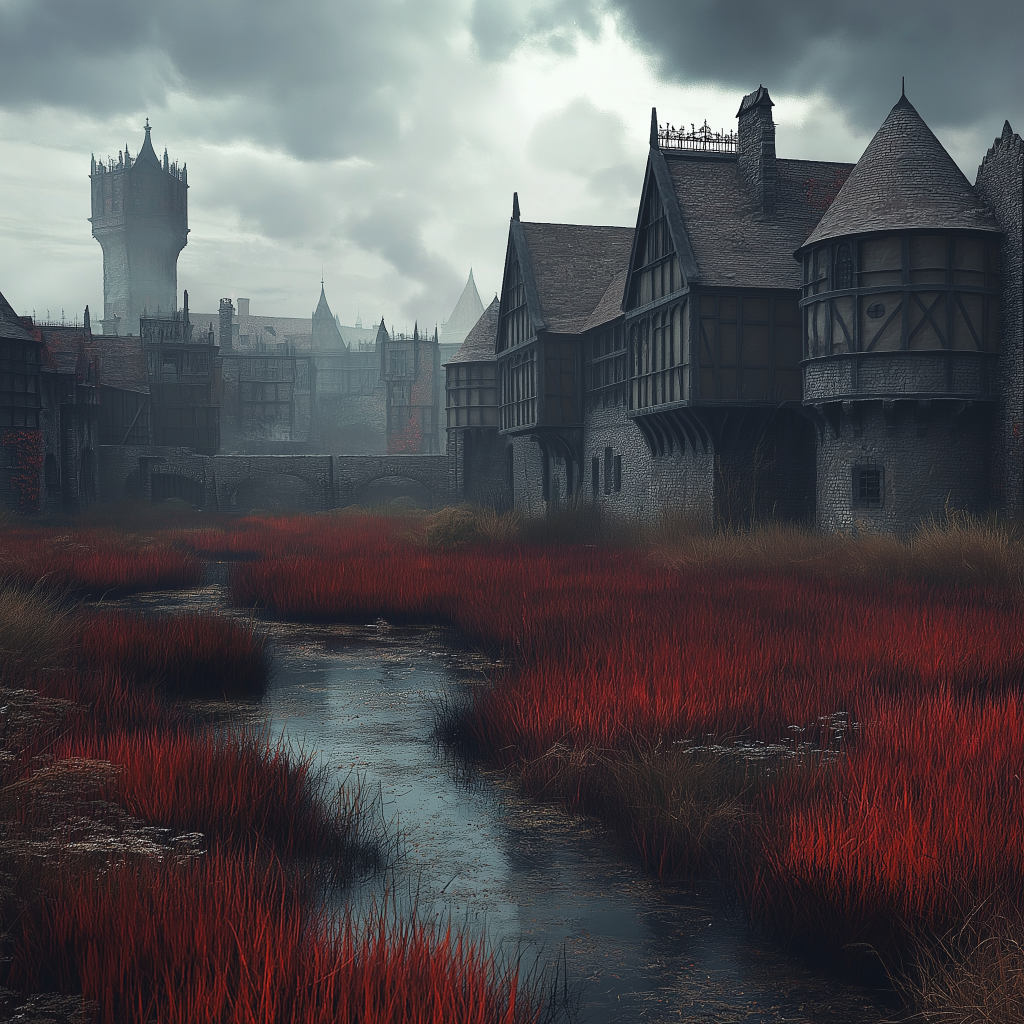
The hamlet of Grendith Cross, the only true bastion of civilization in the Red Marsh. Enjoy your stay.
Grendith Cross: Grendith Cross is the largest settlement in the region, with the largest amount of bounties and second only in trade, legal or otherwise, to the Farmer's Market one shell below. The present site of Grendith Cross was once home to a civilization that collapsed for unknown reasons after the Spire connection failed. Whether it was famine, plague, betrayal or invasion, all that is left are the skeletons of their concrete and steel buildings.
These buildings, partially flooded and built up and around by wooden boardwalks and fitted cobblestones, give Grendith Cross a patchwork appearance, the imposing metal walls protecting cramped and teetering houses of wood, scrap metal and stone. A scuffed dome surrounds the silverwood tree and the inner ward at the heart of the ruins, though half the panels are scarred and clouded.
The outermost ring of ruins are partially flooded, the shores of a nearby lake having shifted to lap against the towering blue-gray steel of the walls. Most travelers will only see Fisherman's bridge and the Traveler's Ward, parts of the city sectioned off to service and contain them. Although there are windows, there is no glass. There are no reflective surfaces of any kind.
The narrow cobbled streets of the Traveler’s Ward are filled with natives as well, but they tend to be outcasts of their own. Fanatics. Maimed bone carvers still obsessed with their craft. Fringe alchemists and anyone mad enough to seek out the dark mirror realms on purpose, hoping to secure bargains out of greed or desperation. The inner rings and the tree itself are reserved for the guilds and the native families of Grendith, but even then a seeping paranoia has taken hold of the city. There are whispers that the tree protecting them all has died, and the tri-part council of Healer, Hunter and Merchant are covering it up.
The Desolation
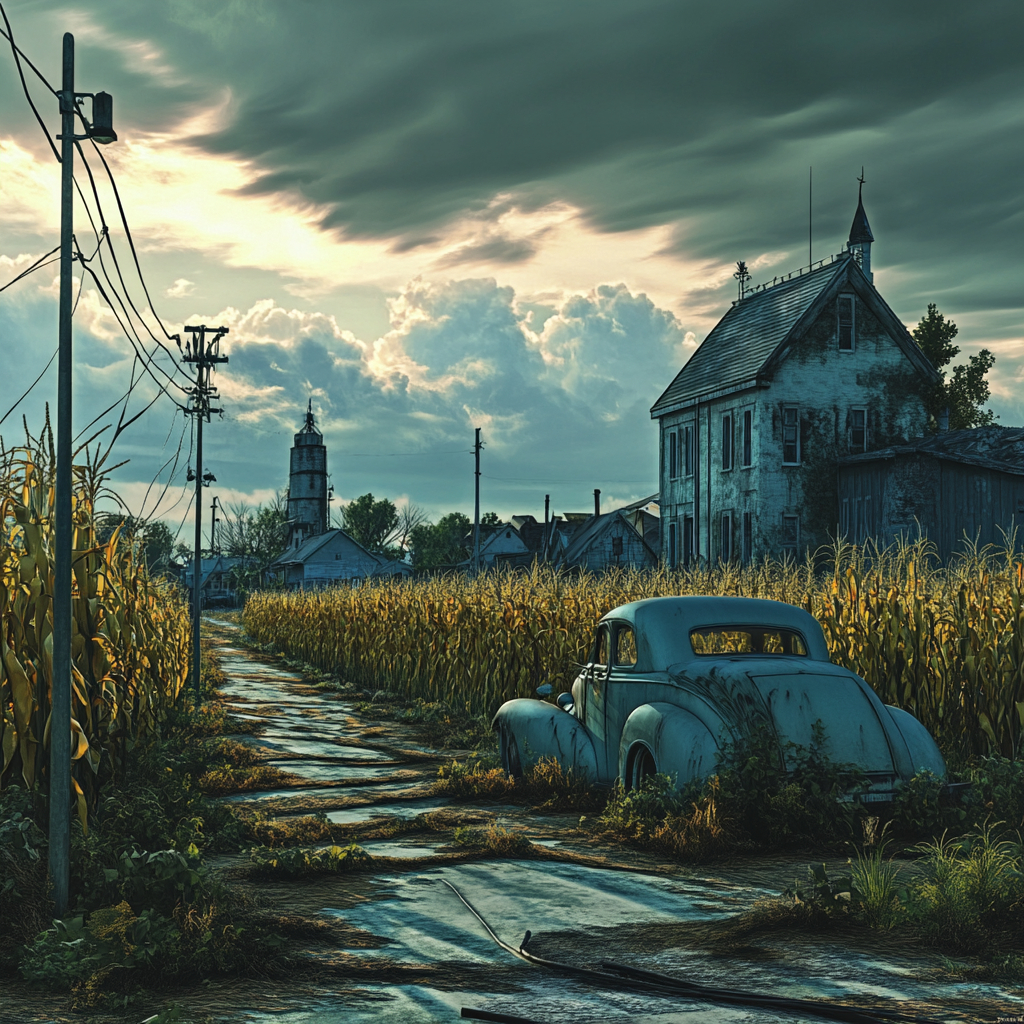
Abandoned ruins and attempts to settle the Desolation dot the land, the bones of civilizations riddling the Plate like an upturned grave.
The Desolation is the intense and permanent haunting of a land upon which countless horrors have been visited, with secrets too large and wild for most to really comprehend.
Stepping out from the Spire brings you to the Visitor's Center. A long abandoned complex made from the shells of giant beasts, the bones of factories and the wreckage of train stations, military outposts, temporary housing and barricades.
The Center encircles the Spire, as does the floor which is smooth, slightly textured and entirely laserglass. Old quarantine banners still hang on some of the buildings. Graffiti, half finished wards of protection and gang symbols layer the walls. Further investigation would reveal a museum long gutted by looters.
Scorch marks, plasma fire and claw marks pepper the walls. The complex has been turned into a maze of barricades, staircases and boarded up doors. Some of these doors go nowhere. Others go into liminal spaces that can be used to traverse to many points in the Desolation and beyond, if you want to risk the ever more crazed looping corridors and 'backrooms' that eventually break apart into the drained characteristic nothingness of the Dead Sectors.
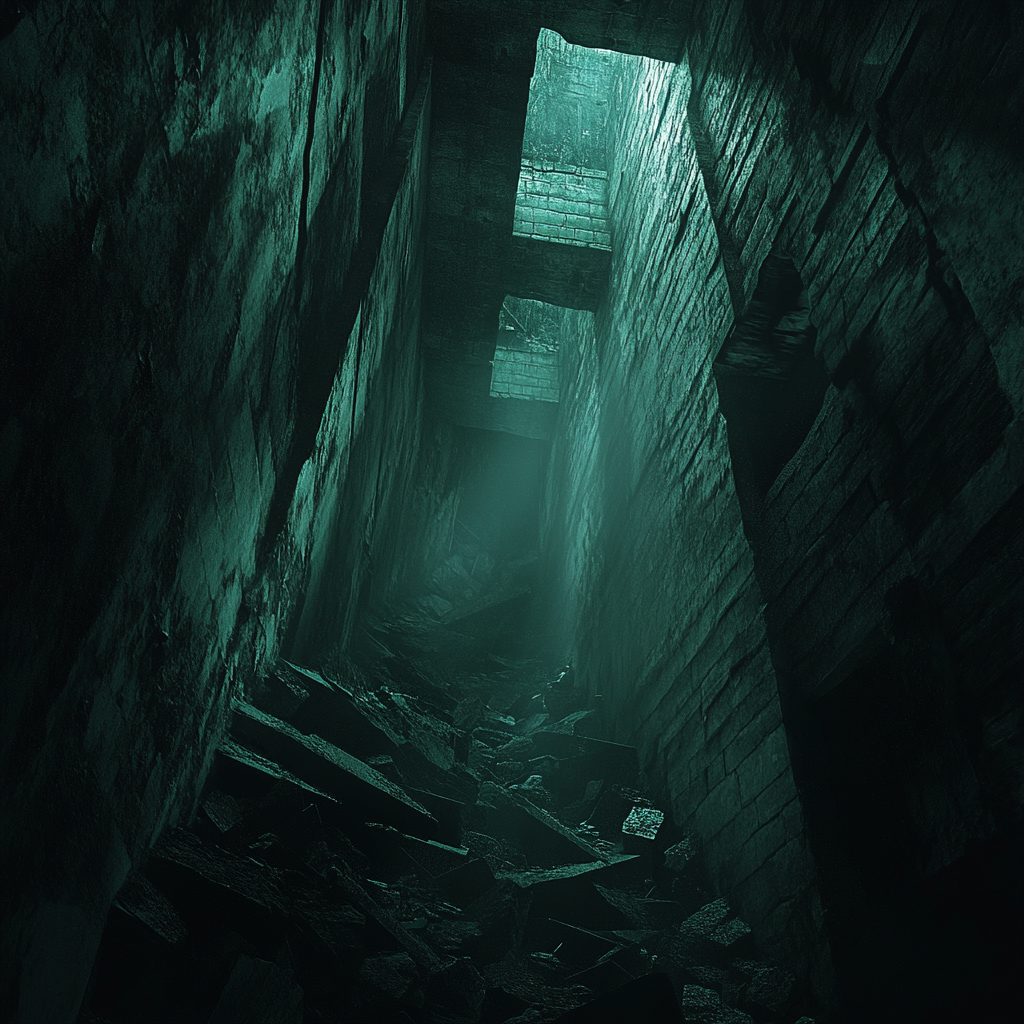
A wrong turn in the Backrooms can lead to more than a dead end.
Smugglers, bandits and scavengers eke out an uncomfortable existence here, trading mobility for safety with the ever looming threat of the Spire's fluctuations and the 'backrooms', as well as anything that lurks there, spilling out into reality.
Still. Connected to these endless corridors are fragments of the past as well as the caches left behind by other residents. The rules of reality may bend or even break, but ancient libraries, hidden armories and forgotten reliquary vaults tempt the brave and the foolish.
If you fly up from the Visitor's Center or leave by the main roads, you find the Desolation proper to be just that. Urban ruins. Cracked streets. Abandoned vehicles. Empty churches. Miles upon miles of arid scrubland struggling to survive while patches of withered, bleached soil dot the landscape.
A number of roads extend out from the Center but quickly devolve into cracked stretches that fan out into nowhere. The wilderness has reclaimed most of the buildings, in bitter conflict with the creeping patches of cracked soil which gleam with an eerie blue glow at night, reminiscent of Cherenkov radiation.
Those few who live here have come to term it 'The Withering' for not only it's effects on the wilderness, but the tendency for strange phenomena, mutated creatures and crazed constructs to be more frequent in it's presence.
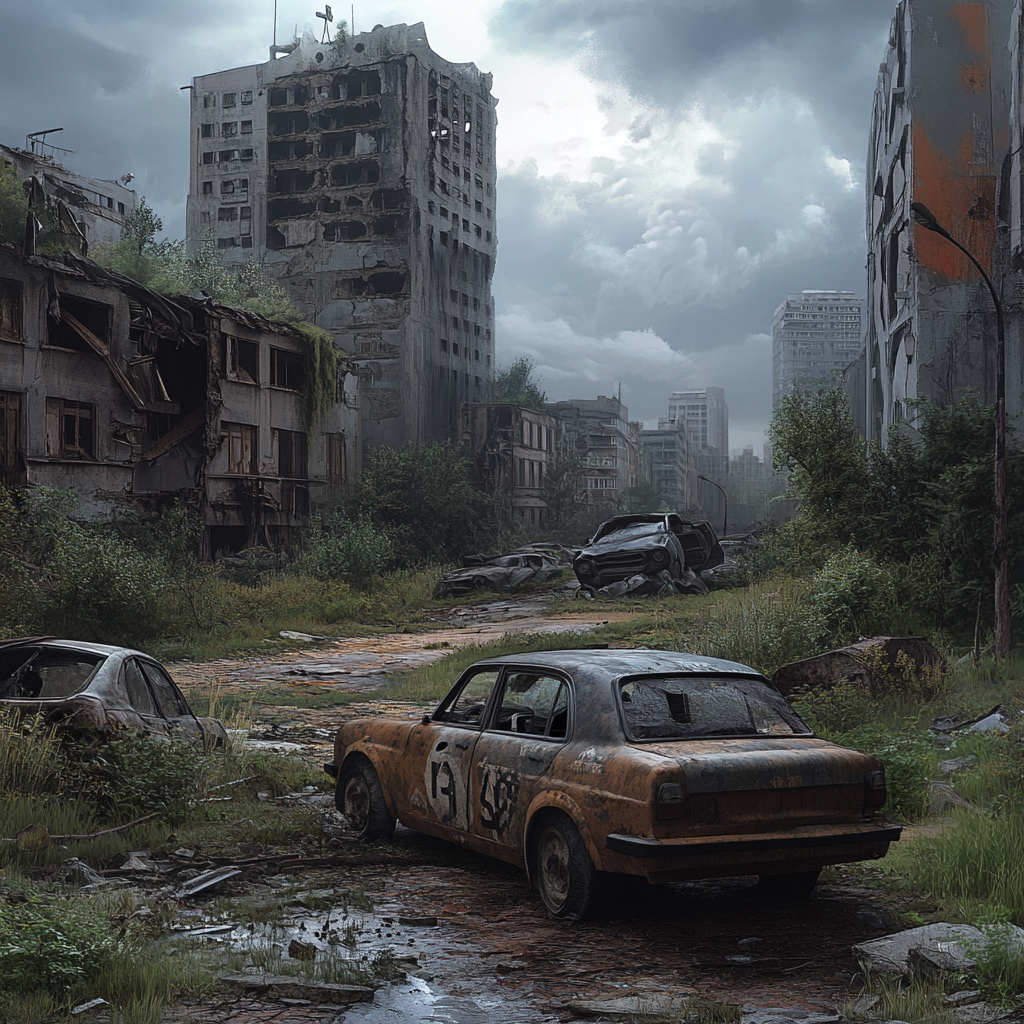
The Desolation stretches all over the second Plate, a reminder that not all is simple or civilized in Grand Convergence.
As you move through the gaping wilderness from junkyard to ruined energy station to fallow and abandoned farms still crewed by dutiful automata, there is a sense of growing malice. Pockets of ruin and wasteland where life itself is unwelcome, or where the comms field picks up a steady, relentless static. The weather or the artificial day/night cycle has been known to glitch out in localized areas where artifacts or the lingering effect of magical disaster has warped the terrain. Off the main roads, there are often grisly tableaus of stranded Travelers or frozen rockslides where time itself has broken down.
Beyond the Desolation, there is only Cerise. The most populated, and most dangerous, settlement on the plate. On the outskirts is a big friendly sign built from the hammered out scrap taken from some ancient warmachine. Great corroded gashes have weathered the surface, making the words barely legible.
The Withering has reached the farms, fields and sheds encircling the town. The roads regularly have to be cleared, as the highly invasive, razor sharp stalks of metal that vaguely resemble corn regrow practically overnight, encapsulating the town. They turn to ash when struck, returning even more distorted with each culling.
There is little knowledge about how Cerise came to be. It has all the comforts and amenities of civilization but it -- from buildings and signs to neatly manicured trees, grass and shrubs -- is a careful facsimile done in glass and scrap metal. It also has a peculiar 1930's Art Deco aesthetic, complete with gleaming chrome, stainless steel and mesmerizing geometric shapes.
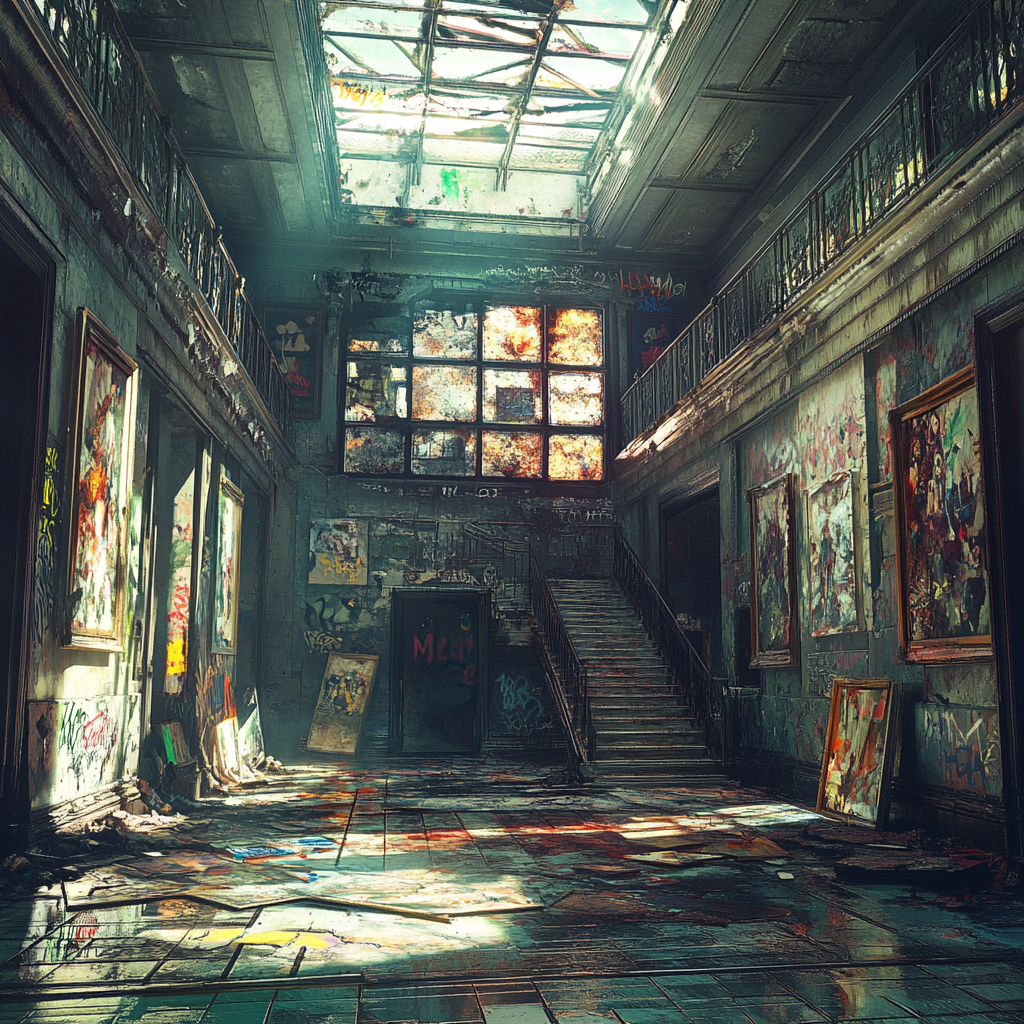
You will not find any reflective surfaces or pleasant art here. Not where hands can reach them. Where eyes can see them.
There are no reflective surfaces. Every statue, book, picture and street sign has been mutilated into faceless oblivion by scratch marks. The town has a washed out quality to it, muted colors and cracked pavement blending into a muddy sameness save for bright, garish red highlights.
Cerise is one of the few remaining shelters from the effects of the Withering. It's also the location of the Farmer's Market, the largest black market in all of GC and a powerful interdimensional pocket realm that exists on a tiny cul-de-sac called Harvest Circle. The town is bustling with activity, though violence always remains close to the surface. It's a crowded camp of scavenger gangs, fanatics, smugglers, mages, necromancers and the insane. Few regular people survive in the wastes, and an excess of predators leads to an endless cycle of predation followed by retribution.
Still, Cerise endures. Any damage sustained by the town repairs the next day, though, like the fields it grows back stranger each time. Some of the worst places and frequent battlegrounds draw the occasional crimson spark and an ominous feeling that pushes the remaining people into a smaller and smaller ring of safety.
Culture
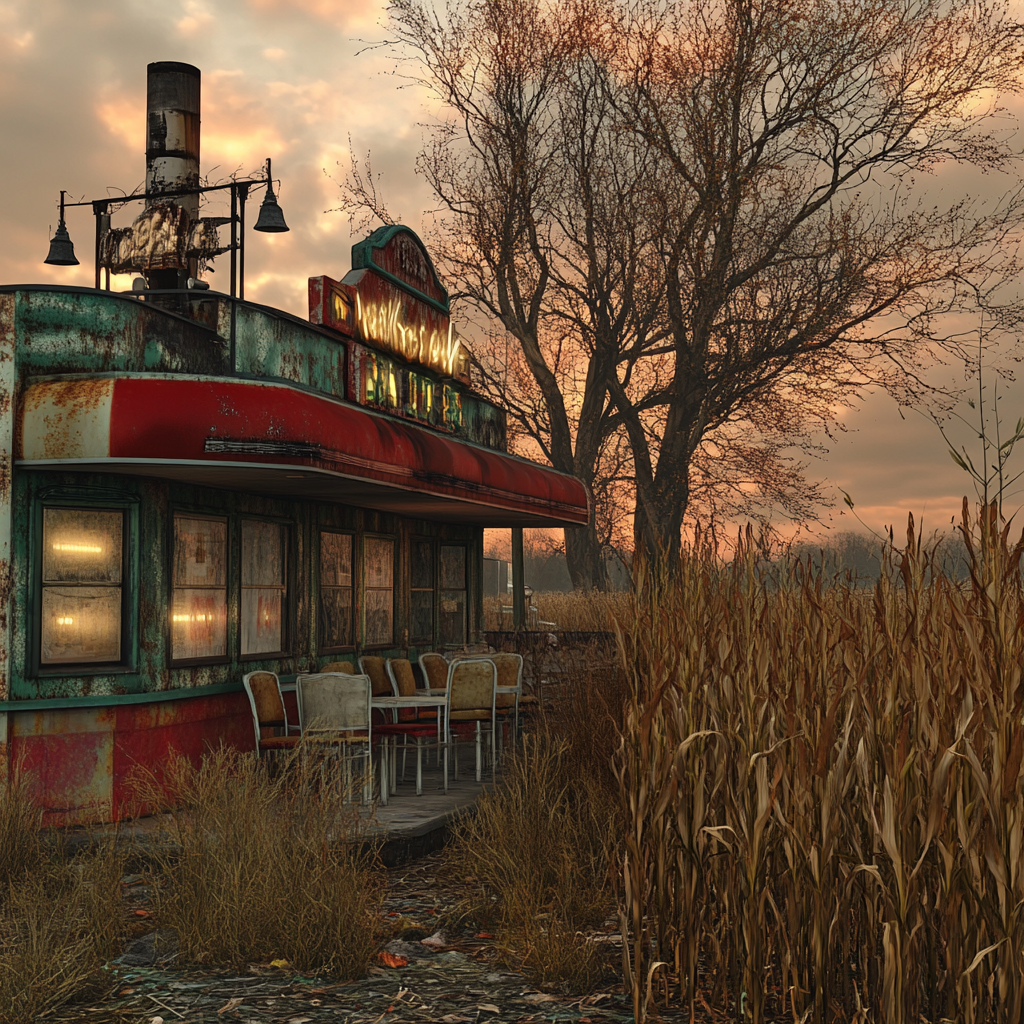
There was an attempt to make a lovely place to rest and relax here. To find other people. To get a bite to eat. It's gone now.
The Desolation doesn't really have a culture. The surviving population is too small, too scattered and too predatory for that. There are small communities of which Cerise is the largest, but a lack of firm leadership and resources cripple the ambitions of most.
What it does have is a series of rough guidelines that are ever shifting depending on who is currently in power. Scavengers prioritize the wastelands while Smugglers turn their attention to the backrooms and the market. Everyone wants something from the Desolation. They want to hide, or explore, or discover or build -- and they aren't afraid to rip out a place for themselves with their bare hands.
There is room enough for all, but support for none. Trust is a commodity out of stock in the Desolation, and reinforcements aren't expected anytime soon.
Points of Interest
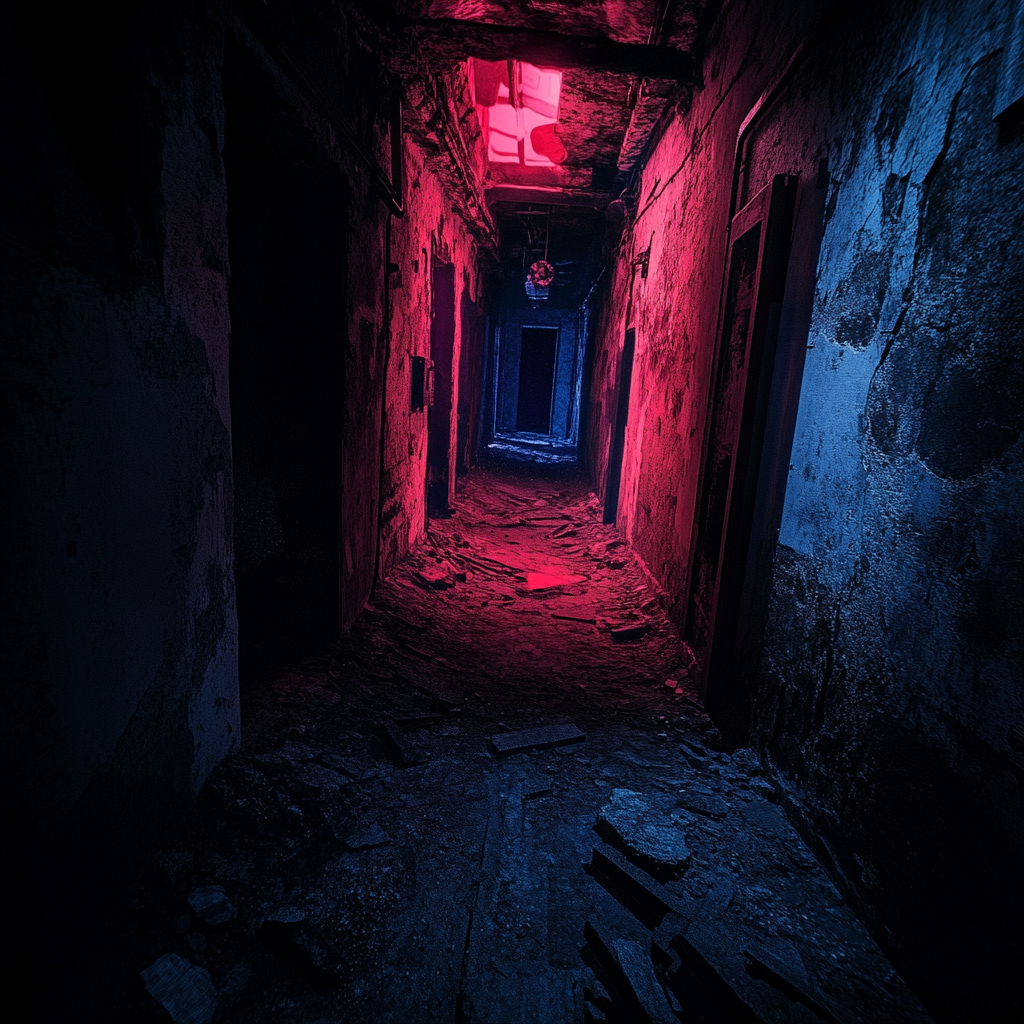
The Backrooms lurk beneath and behind many places in the Desolation. Sometimes they can be helpful. Sometimes not.
The Static: Emanating from somewhere within the Spire itself is the Static. The comms field is full of it from the instant one comes into range of the Second and Third Shell. It's a solid, relentless curtain of noise that provides the backing track for every conversation. It can also be heard from most electronics and even constructs out in the wilderness. Occasionally, a few bars of music or fragments of words can be heard when traveling through Cerise or the Backrooms, but it's hard to make anything out.
The Farmer’s Market: The Farmer's Market is an interdimensional space barely kept within the boundaries of a tiny cul-de-sac named Harvest Circle. It's the only part of town that isn't crammed with refugees, grifters or territorial disputes. This is usually because the most powerful keep the market heavily guarded, even as it becomes gradually more unstable. There is a chaotic tumble of tents, gazebos, 3D-printed stalls, floating tables and individually tailored spaces.
Anyone can set up a stall providing they can protect it, as physically kneecapping your competition is as common as undercutting their prices. There are constant squabbles about location, as some 'turns' of the circle are more stable and safer than others. 'Browsing' can be dangerous in this space. One has to keep a firm idea of what they want in mind at all times or risk getting lost amongst the endless decaying loops.
Because of the danger, or in spite of it, control passes from hand to hand quickly. More than a few covens of witches or alliance of mages tried to stabilize the Market for their own ends, to little avail. Once a week, it turns into an auction house, a sort of 'Night Market' where all the goods seen are collectively being auctioned off in staggered batches to prevent wandering attention.
The Skorch
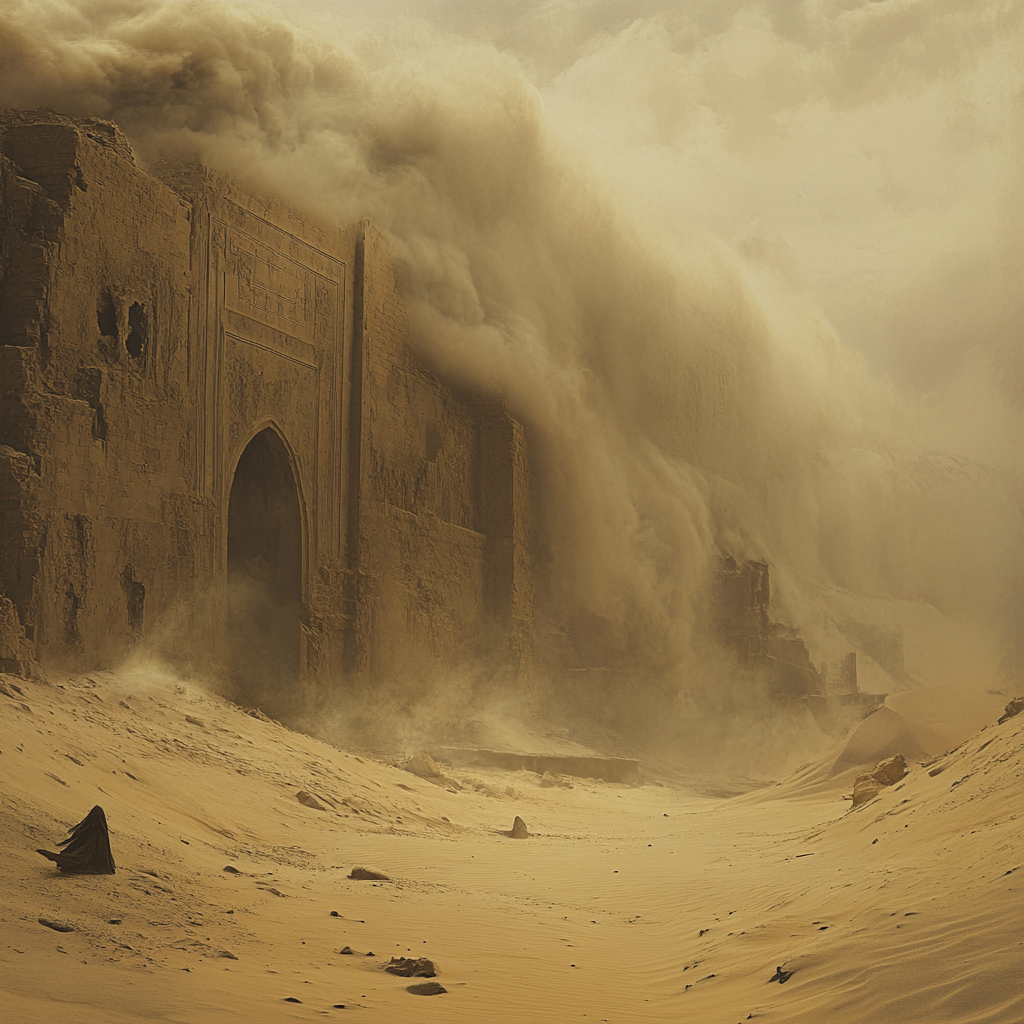
The Skorch, as the locals call it, is a land of destruction and opportunity, a crucible that punishes the arrogant and rewards the strong and clever.
The deepest parts of the Lost Sector are the strangest, the most dangerous and the most profitable. This was not always the case. The plate used to be dead and seemingly uninhabited, a tangled plate-wide junkyard sizzling under the weight of Delerath's ceaseless industry. An oppressive atmosphere was created by waste heat thrown off by Delerath’s machines. Although that deterred some, the dedicated and the desperate stripped everything of worth from the carcass. At least, everything they found and understood to be valuable.
Whatever was out in the ruins, few saw the signs. The plate had been abandoned by Travelers for so long, whoever had tried to cultivate a home here was long lost to memory. Some speculate that it was a fungus that triggered the change, a metal-eating strain grown fat on the heat and plentiful material. Others, a crazed AI of some flavor. Whatever happened, it triggered a regional Quarantine purge.. and in the wake of that Quarantine, something ruptured.
The ruins came alive. Old industrial projects and ancient terraforming protocols fought with nanite builder swarms and golems formed from rusted scrap iron. Walls and canyons rose and fell in a matter of hours while a howling wind from the center of the plate kicked up a storm of dust, glass, volatile gasses and razor sharp fragments of debris. This was the beginning of the stormsurges, a series of sandstorm like pulses that would burn and scour the shifting lands underneath.
For a long time, nothing changed. A dangerous environment is measured only by it's worth in contrast to the danger, and few saw any worth to the place some were starting to call the Skorch. When it was discovered that the stormsurges could be predicted, or even mapped out to a certain extent, it became more useful. The surges play havoc with machines but that was simply a matter of handling the problem better than the one chasing you. Not that everyone succeeded. Crashes and forced landings revealed another aspect of the Skorch. At least to those who survived.
The shifting lands under the stormsurges were not just simple, stripped bare materials and animated junk anymore. The multiverse is a vast place, but here could be found mythical materials from far flung corners whether the Spire connection to those places was recent or not, or in some places, materials that either cannot exist -- or should not. These temperamental byproducts of the shifting storm are poisonous, volatile, perishable or all three.
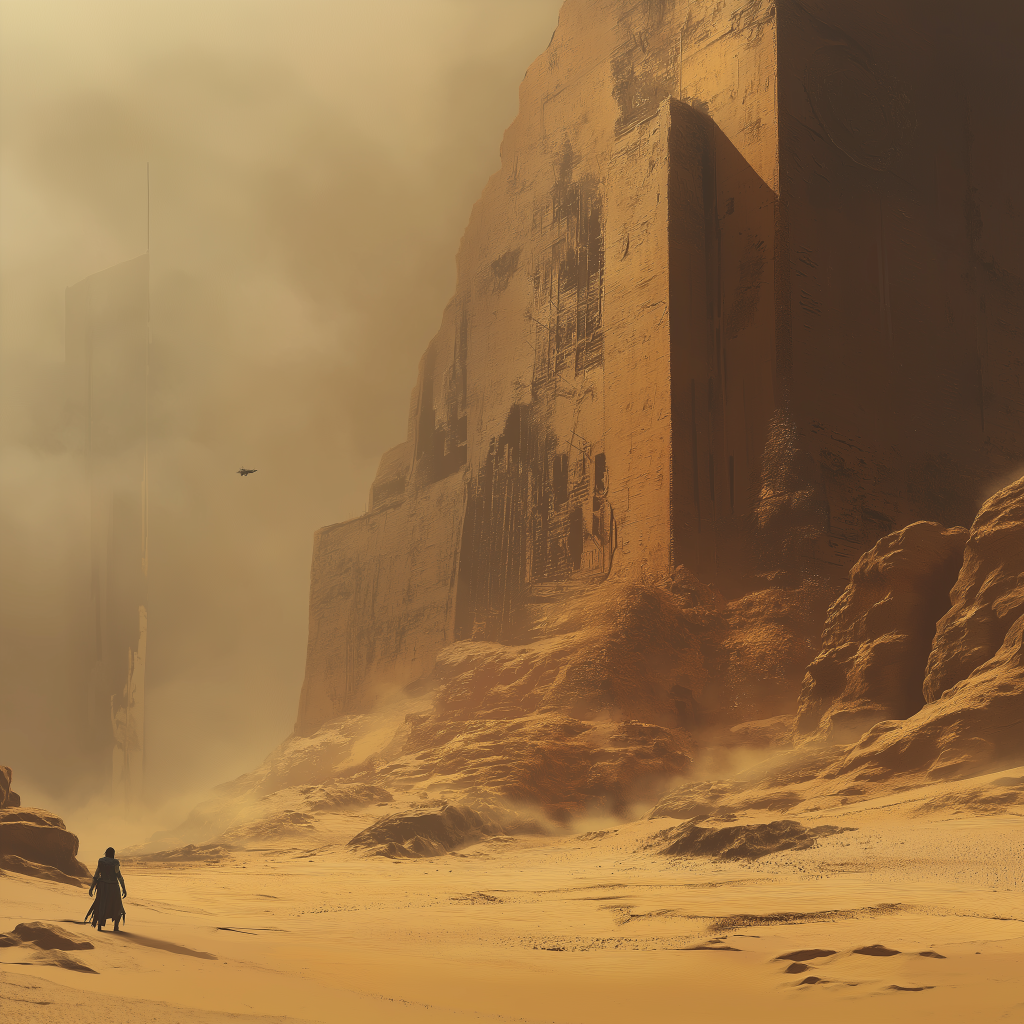
The stormsurges of the Scorch batter down and shred anything caught in them, but what is left is potentially more valuable than what was there before.
But scarcity, even temperamental and dangerous scarcity, draws attention. While the shifting terrain has calmed over the generations into a steadier rhythm, the entire plate can shift in a matter of weeks from plains to canyons to steep valleys and mountains. Things have also come to live in these wildlands, creatures of immense power and cunning that have seemingly sprung from nothing. A disjointed ecology that makes little sense and frequently breaks down, only to adapt and come alive again.
The only place that does not change is a wide, broken circle of stone surrounding the Spire. The weathered sandstone walls have been engraved all the way around with runes and symbols in many different languages. Most of which have no modern equivalent or translation. The ruins of a few humble, nondescript buildings cluster around the Spire's base, but they have been mostly destroyed by strange rods of metal vaguely resembling corn stalks.
Culture
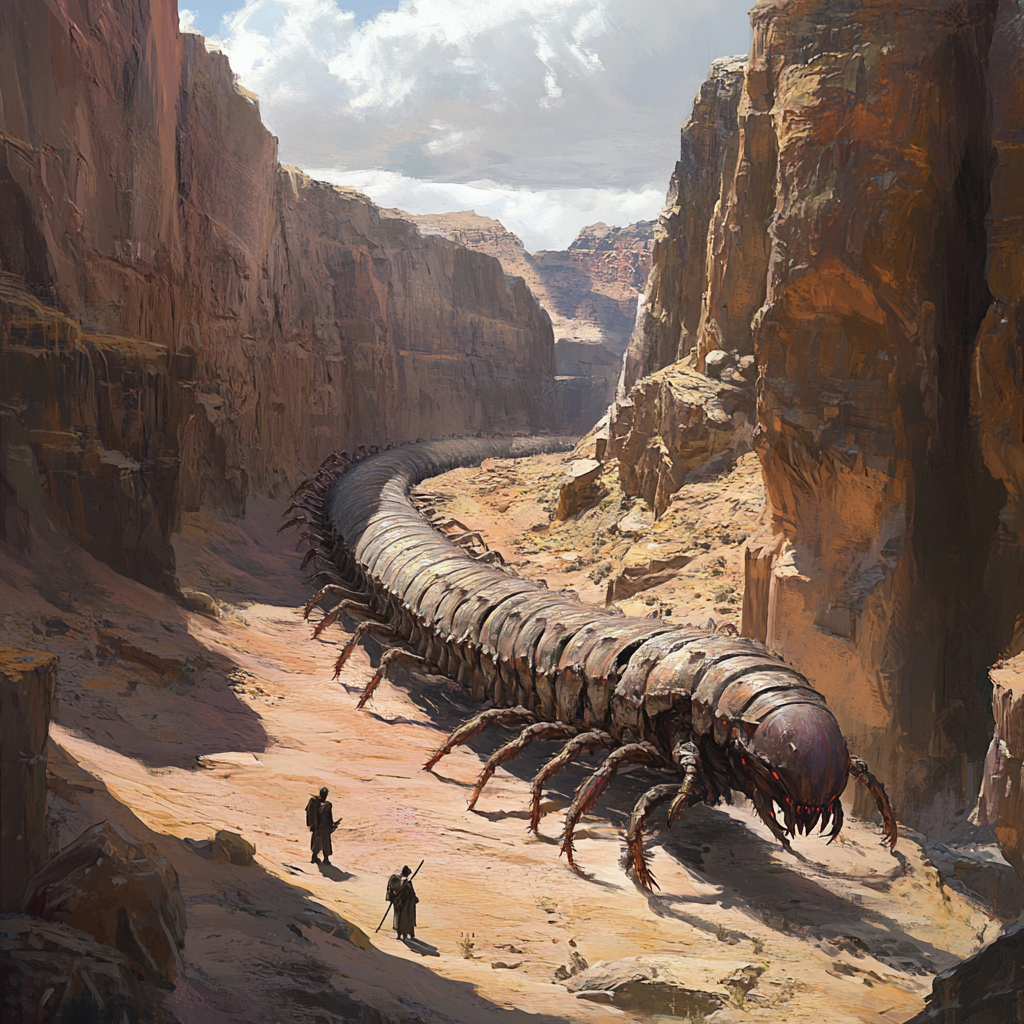
Gigapedes are one of the many potential threats that can be found in the Skorch. One of the most common, and only the first of many problems keeping the place from being studied and tamed.
Only a certain type of explorer comes out to the Skorch. Mirages are common, particularly towards the center. They can be as small as a palm sized hologram or stretch for miles, hiding a chasm from sight or promising water or shelter where there is none. Several competing groups scavenge materials from the Skorch, but none can say to have claimed it. At best, they navigate the stormsurges and lead a nomadic existence as the plate shifts over time. Certain storm conduits and technology can be placed to stabilize small patches, but that stability tends to draw the attention of the giant gigapedes that serve as builder drones.
There are also signs that a large underground space once existed near the center of the plate. Sometimes the land will shift enough to uncover hallways and corridors, or even cavernous chambers crammed with broken electronics and dead power conduits. Even more tempting are the Vaults, seemingly pristine containers of unknown technologies and.. sometimes just books. Strangely, some of them are crammed with books. Most of them are fictional, and all of them are blank.
Those nomads who traverse the wastes have all sorts of inventive ways to make their way through the landscape but one of the most popular are wings of various styles, some even stolen or reverse engineered from other districts. These make travel more viable for small scavenging parties with flying vehicles used sparingly as they are more difficult to shield and more difficult to replace when damaged or destroyed. Mobility artifacts such as boots that harness the oppressive heat are also common, though at the risk of burning yourself should the relic draw too deeply on their energy reserves.
Points of Interest
Blank Memorial: Embedded in the wall of sandstone on the southwestern edge is a rectangular block of corroded scrap metal, a smooth obelisk made of many interlocking pieces that flow into each other. The front bulges out just slightly on the right hand side. There is no adornment save for a pitchfork buried in the soil nearby and a flimsy blue paper tag that does not come off, no matter the force applied to it. It reads. "Hi! My name is ____" in jaunty, eye-wateringly white font.
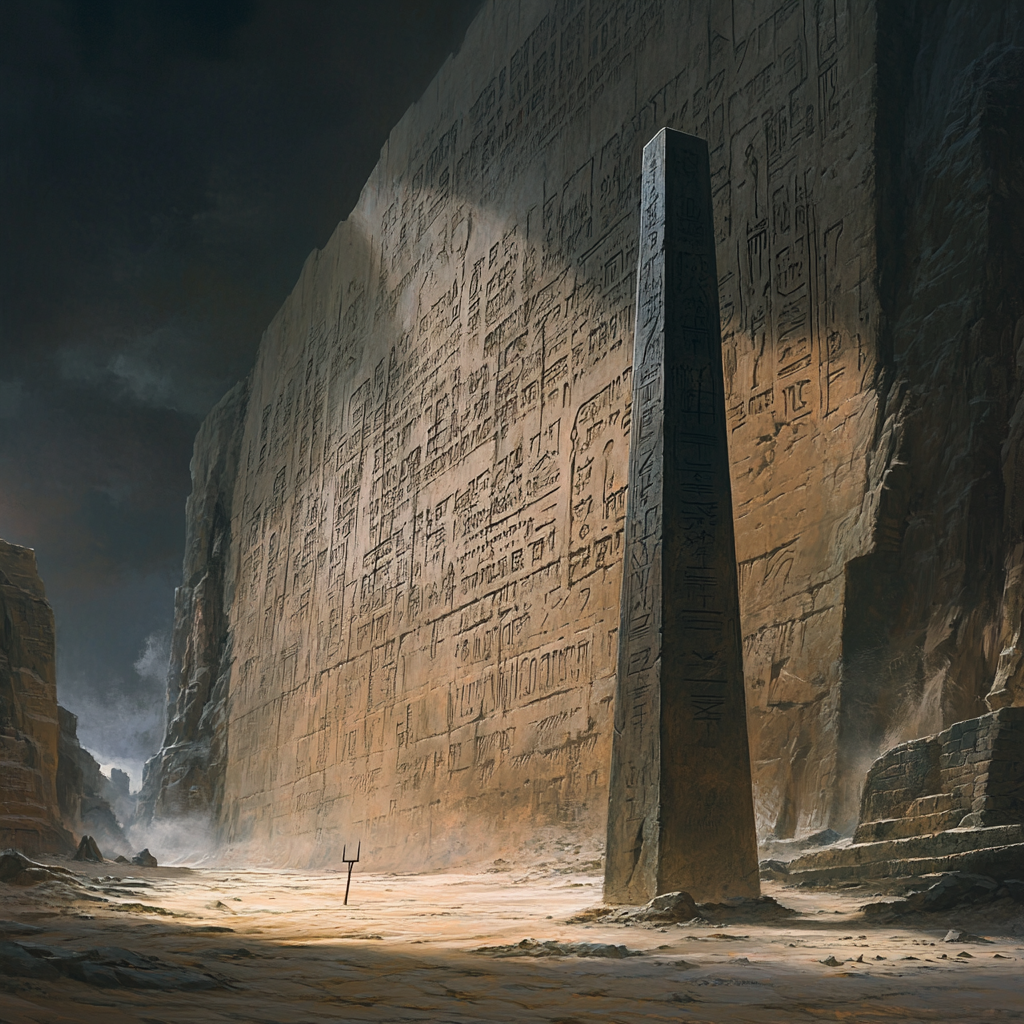
A small segment of the Godgraves. Be careful what you touch, it just might become all too real.
The Godgraves: The center of the plate is the 'Eye of the Storm' and abnormally calm past the thrashing stormwall just feet beyond the outskirts. Every inch of the terrain here is carved with vibrant images and text. The stories and living sagas of many Worlds and cultures. These images will often spring to life at the barest touch, spawning monsters and wonders in equal measure. At the heart of the graves is a font of creation. A storm of boundless energy flowing up from an artifact warped by time and damage, constantly animating and forming new life like an immune system reaction gone out of control. There is no telling what that energy can do to whomever comes into contact with it… Or what it will do to objects in the area as well.
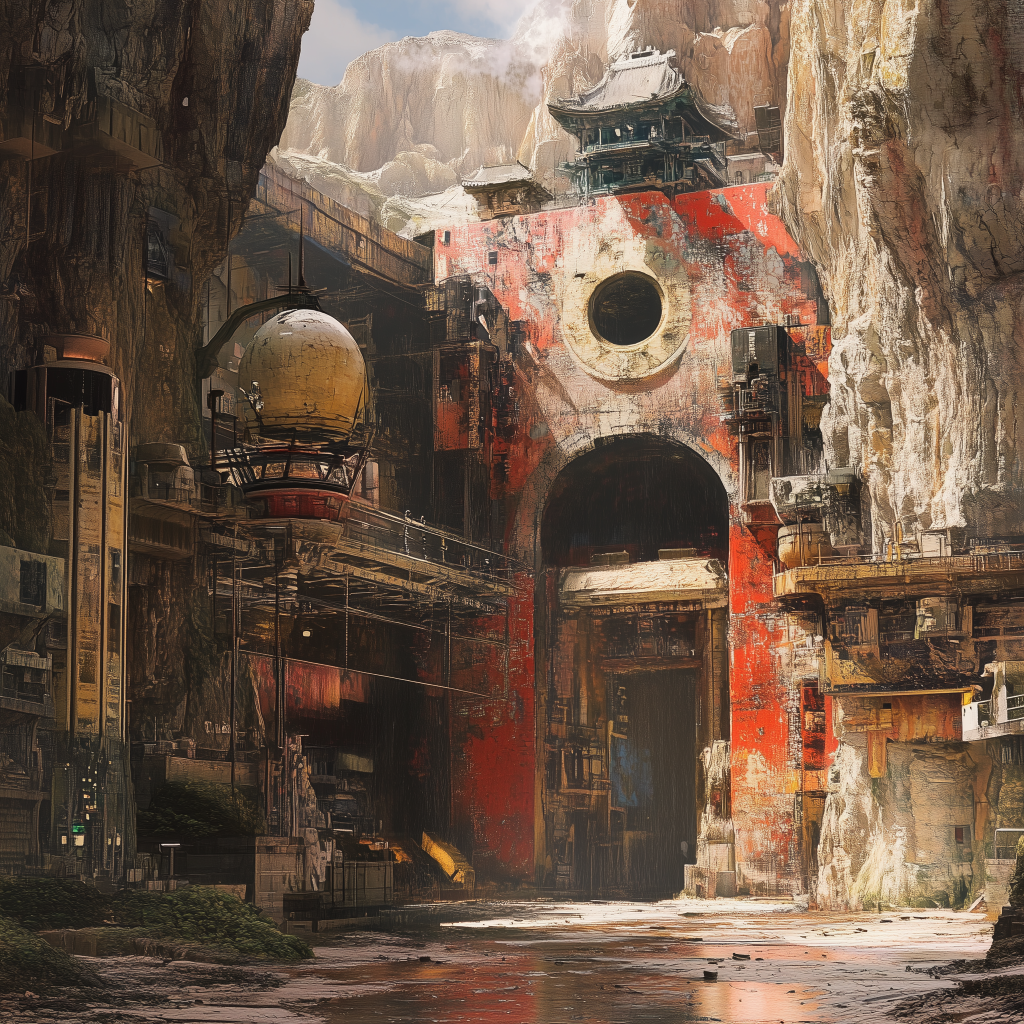
An entrance to Gobos, the Nomad term for the layers of dead technocity beneath the Skorch. Watch your step.
Gobos: What the nomads term the dead city underneath the shifting plate. Very little remains of the highly advanced technological city mostly populated by puppet-like automatons. In one of the largest surviving chambers, revealed perhaps once a year under failing conduits, is a cavernous tomb to a dragon-like creature of steel and electronics whose scales are theater masks. Electronics have a tendency to glitch out here, afflicted with a static very similar to the Desolation, but the source of continues to evade even the most intrepid inquiries… And the Chorus isn't asking questions.
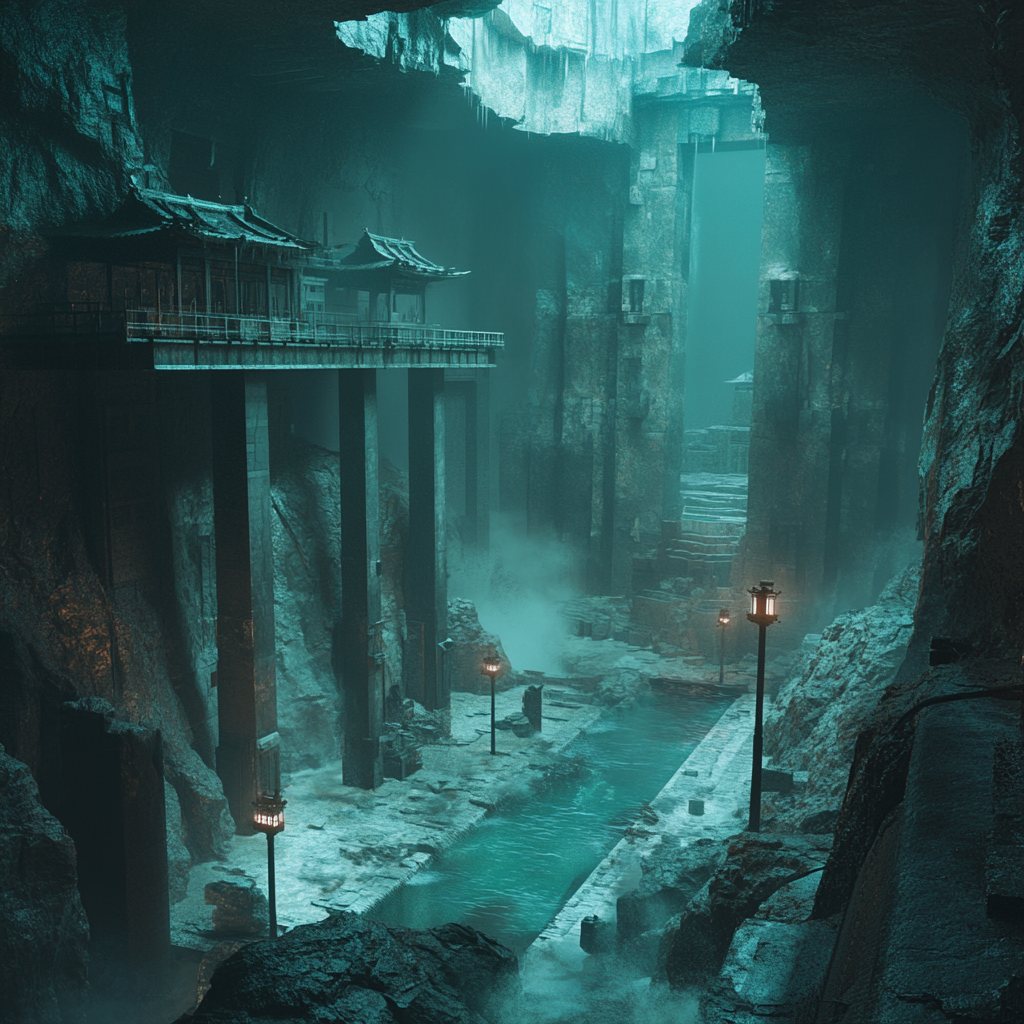
A hidden hideout of the nomads of the Chorus, seeking shelter from the horrors of the Skorch.
The Chorus: The largest nomad community takes their oasis with them as they travel, using a limited terraforming technology combined with storm conduits that seem more resilient to the storm's predations. A scattering of humans and multi-limbed automatons wearing theater masks, swarms of small metal scarabs roam the terrain, beating back nanite swarms and throwing off the hunting signals of the Gigapedes.
The nomads are suspicious and hostile to outsiders, particularly those interested in Gobos or the Godgraves, but can be traded with if treated with respect and patience.