Society

WE LIVE IN A SOCIETY
As one might expect from a place like Grand Convergence, the social requirements and structures can be complex and detailed, with many nuances borne from an endless flow of culture and tradition impacting one another.
Economy and Trade
Grand Convergence survives on trade. There is a relentless import/export process between what can be created locally and what must be traded or harvested from other Worlds. Industrial inputs in particular are of high value, making metals and inorganic materials in constant demand. Everendel produces most organics that people need, though some have exotic preferences that create a constant luxury market as well.
Art and knowledge from other Worlds are highly valued, though it tends to be a difficult or exotic matter to acquire them. Any technology or magic dependent on a specific material tends to get little to no traction from Grand Convergence, though people selling such things are welcome to pass through. The people of Grand Convergence are wise to eager scams made by Travelers trying to create a dependant population, which proves difficult when the 'local specialty' may become forever inaccessible at any point.
Gapcrystal
Or: "What is money, precious?"
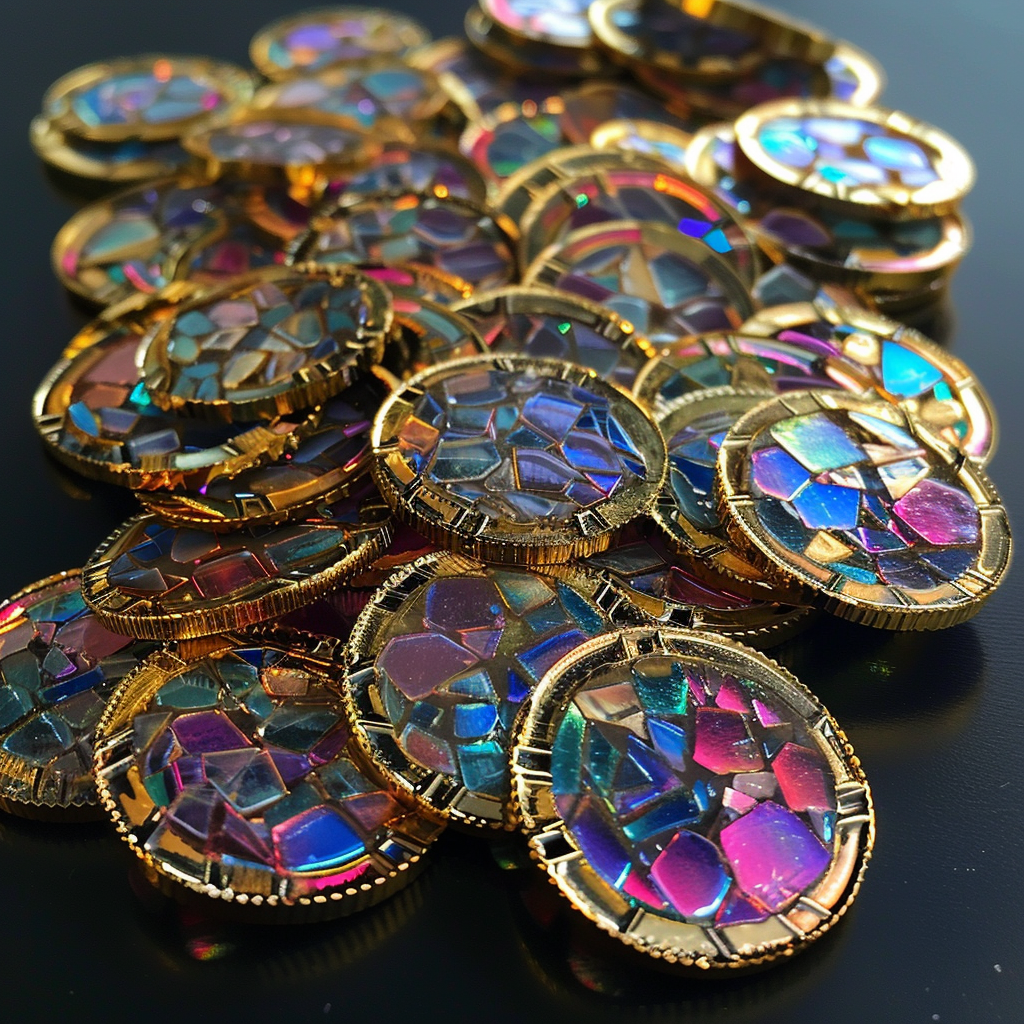
A small pile of GP, ready for use in trade or Spiretech.
When you have access to potentially any material in existence, the question of what you base your local currency on tends to be an issue. It must hold some intrinsic value as well as rarity, with an ability to be harvested but not endlessly duplicated. A solution to the problem was hit upon at the borders of Gapspace, in a quantum foam which can be harvested with specialized equipment. The people who work to harvest this material are called Prospectors and lead a dangerous but profitable life, usually with a cut of anything they bring in. This material can be brought to the local mints of Drasin and converted into a stable crystalline form. This form, called 'Gapcrystal' is then processed into 'Gapcrystal Prisms' or 'Prisms' for short.
GP is extremely useful in GC society, but it can't be taken from it. Once GP enters a Spireway, it begins to quickly melt back into raw Gapspace leaving behind the binder metal, relatively worthless gold. Because of this quirk, the banks of Grand Convergence store prisms in their vaults, issuing promissory notes of various values to be traded for the equivalent amount. All GC banks trade in prisms, either directly or in notes, and are expected to be able to provision an appropriate amount for a legitimate exchange.
This reliance forms the backbone of the GC economy. Everything can be bartered into and from GP. Foreign world currency exchanges will happily convert coins into GP and back, though the exchange rates may vary based on arbitrage and how much you can trust the exchange.
GP can also be used for a number of advanced Spiretech (Also called Gaptech) applications. The energies can be used to craft Beacon Tokens, allowing vehicles passage along the Spireways. They are also used to charge Gapspace Bubblies, allowing people to survive the raw reality-breaking nature of Gapspace for a short time. The most important use for GP is the stabilization of a Dead Sector, repairing the tear in reality at the heart of it and reimposing reality on the region. This process is difficult and extremely dangerous. There may be other, more esoteric uses for GP, but time will tell if they bear fruit.
As an OOC measure of buying power, 1 Gapcrystal Prism is generally considered to be worth about 100 US dollars. GP are often traded in fractional amounts, called 'chips' to cover smaller transactions.
Government
Grand Convergence is organized by the Grand Convergence Council (Also known as 'The GCC' or 'The Council'). The Council has representatives for each District, though the Lost District seat is traditionally left empty. The GCC handles day to day affairs and attempts to organize the redress of grievances from the populace, as well as other organizational and logistical issues that affect all of Grand Convergence. Council seats are gained by election, though one must be a Castaway resident of Grand Convergence to have a seat on the Council.
The Lost District seat can be claimed, but someone must establish and maintain a proper civilizing force on the area first. Many have tried, and the failed results continue to be strewn across the deadly plates.
For more details on the Council in specific, see the Faction page.
While there is not an explained list of laws in Grand Convergence here, you can expect there to be a general shape towards forbidding the usual anti-civilization criminality (Murder, theft, various forms of assault) as well as several other points:
- Grand Convergence is very much aware of supernatural abilities and both incorporates them into daily life as well as enforcing against their abuse.
- Direct mind control is considered a form of assault. Telepathy is not.
- The Grand Market Initiative has a charter from the Council to ensure that markets remain generally intact from potential excesses of multiversal contact. Conjuring vast amounts of wealth to destabilize markets and niches will attract enforcer and Fixer attention at least, and Arbitrators at worst depending on scale.
- Using clairvoyance and other remote viewing methodologies to spy is generally illegal.
- Just because something is not specifically forbidden does not mean it is okay. In a multiverse there are infinite corner cases.
Religion
The religion of Grand Convergence reflects that of its people. There are a number of minor deity figures in GC who, for a variety of reasons, sought out Grand Convergence for solace or exile -- or, in one case, happened to ascend to godhood on their own. The pantheon is small, generally working together to help keep things stable. (With one notable exception).
The deities possess a limited amount of raw divine power and by common accord limit their active presence to their temples in Anos, with exceptions made for festivals, sacred days or necessity (again, with one exception).
Metria
Surprising no one, Metria's temple also serves as a casino. High stakes and rich entertainment can be found here, with currency of all shapes and sizes being wagered. Servants of Metria often serve as fortune tellers and oracles, though when pressed they will often admit to having no actual ability to manipulate or accurately deduce the future. Selling good luck charms is a brisk business though none but Metria know if they actually work, and her answers are always evasive. Research studies done by Istamnir in the name of progress have simultaneously proven she does and does not influence the results, to the great amusement of the deity in question.
Transhon
There are many traditions concerning Transhon, stretching back into history. Small shrines appear at every Waystation. The more sedate priests explain that they help keep the Spireways open. This may or may not be true, but the priests do help to provide aid, shelter and basic supplies to Travelers for nominal fees or trade-in-kind. The more adventurous adherents of Transhon, called the Rangers, often go trailblazing themselves, either in conjunction with the Prospector's Guild or with others. The third group, the Rescuers, try to retrieve the lost and abandoned, for which they get the most danger and the most respect out of all of the groups.
As for Transhon himself? He leans a great deal on his disciples to get things done, providing support and advice as he can. This personal intervention is curtailed by heavy restrictions from an unknown source, limiting just what aid he can provide.
Recbal
The god of penitence and justice, Recbal committed a sin against the laws that bound him in ancient times. In response he was sealed and bound, his power and divine aspect dwindling to a sliver of his former self. His very form was obscured, barely able to speak or act.
Despite this, he has no great rancor against existence. He refuses to speak of his crime, other to remark he had been justly punished for it and will serve out his sentence as decreed. Unsurprisingly, he encourages others to earnestly seek repentance.
Disciples and adherents of Recbal are common sight in the justice system, both in those who administer it as well as though who seek to honestly atone. While his power is limited, he exercises it as needed to support those who follow him. Recbal has a particular enmity towards Vorlath, with many of his followers working to contain rampant predation and pursue Hunters they believe to be too wild and indiscriminate.
Orixestes
Although once a mortal, their ascension wiped most of their mortal existence as well as their method of ascension from reality itself. Although a living piece of evidence that apotheosis is possible, they appropriately leave only mysteries in their wake.
Priests of the God of Enigma and their dedicated followings are ushered at one time or another into the presence of their Divine self. Each of them is gifted with a strange musical puzzle box, and what they do with it is their own affair. Some ignore it. Others attempt to solve it, or even destroy it. The box has many layers to it, and while many can reach past the first layers, the second stops even most of the priesthood. A few have claimed to reach the third, but none recorded have passed to the layers underneath.
Orixestes and their followers seek to find the truth and reveal it to the world. They have no patience or favor for those who hoard the truth to themselves or seek to use it to manipulate others. The blessings and curses they lay on others can often be rooted in this base principle.
Vorlath
Vorlath is a violent and savage godling. They roam Aurborea and the Lost Sectors, where divine agreement allows them to prowl as they will. They strike down those they deem as prey, usually someone that has breached one of the laws of nature or an oath they have sworn. Vorlath is a master shapeshifter and can often infiltrate where they live, taking the form of any beast or machine in order to move through Grand Convergence for their purpose.
Worshippers of Vorlath are often those who live by the laws of the wild themselves, or those who have particularly adept shapeshifting ability. The higher ranks of the priesthood are populated with shapeshifters and those who can alter themselves at will, save the rare non-shapeshift who can prove themselves to be exceedingly adaptable and inventive on their own merit.
Followers of Vorlath and Recbal often clash over the definition of where the 'law' resides, with the latter often seeking to restrain the former. They are a microcosm of the constant conflict between nature and civilization. The Spireguard do not get involved unless the conflict threatens a Spire, but many Fixers and other forces are hired on either side to augment the constant skirmishes that arise.
Other
There are countless other deities represented on GC, sometimes supported by a handful or less faithful. If a deity does not choose Grand Convergence itself as a place to remain, it is unlikely they will ever truly rise to local prominence. This is mostly due to the nature of Spireways (See Metaphysics)
Major Races
On the Everen
The Everen are humanoid. They are neither humans, nor elves. This is something people are reminded by, and something people make the mistake of in equal measure. Everen society in GC tends towards a calm, peaceful demeanor. The primary pastime of the majority of the population tends to be that of cultivation. This could be cultivation of the self, the world around them or their knowledge. Wilderness is a resource to be tamed in the service of those capable of control. While emotional outbursts occur, they are considered a social faux pas. Self control and empathy are considered virtues held in high regard, though they often acknowledge that control is often imperfect. As such, what one can cultivate is often restricted. Cultivation of certain types of harmful life such as viruses is usually forbidden unless demonstrations are made that the subject is benign or used only for positive or defensive medical application. (i.e The Bacta from Star Wars)
Form follows function with the Everen and robes are a common clothing choice, as they help to cover many potential sources of modification that other races might find disturbing. Many Everen have decided to graft plant life into their bodies, which exacerbates both some disturbing qualities and the tendencies of others to mistake the Everen initially for elves. Most bear it with equanimity, but.. others might consider it an insult thanks to cultural pride.
Everen music is often created by living and domesticated creations, adding a haunting, ethereal quality to their environments. Most of Everen philosophy revolves around the use of their art of domestication, as well as the ethics involved.
As caring for others is a widespread societal norm, the Everen often use their advanced abilities to heal and purify other beings. The constant panoply of GC makes this a complex challenge, but the healers of the Ever often consider it a point of pride to overcome such trials. Healing, however, is rarely free. Resources and effort must be recompensed, and the subject must wish to get better. Though simple injuries are trivial, deadly or endemic situations can be more expensive to treat. They accept work-in-kind and other forms of recompense, but often when something is free, it is often abused or taken for granted.
The most expensive proposition is often the Everen-style augmentations themselves, both from a resource and cultural perspective. The Everen are greatly proud of their cultivation efforts, and redirect those with simple 'upgrade' wishes in mind to dealers in Delerath, Istamnir or Charnel if they wish to be particularly insulting. The process for works of art such as their augmentations tend to be intensive, with successive treatments being easier as the altered body adapts to hosting symbiotic life.
The Academy of Domestication Arts, or the ADA, provides a full academic and structured background for this research and serves both as governmental building and centerpoint for Everen research. Firmly in the 'back side' of Everen, away from foreigners, the consideration and carefully crafted veils of comfort erected for the sake of other races does not exist here.
Pantries sort themselves. Lantern moths flutter around blinking streetlamps. Buildings consume the vermin that land or skitter around them. Doors recognize their owners and strike back at intruders. Everen do not get fooled by mimics, where the most advanced and exotic samples are kept under strict protocols inside the ADA. To allow one to escape and cause harm is a mark of shame and an incredible loss of status for the Everen responsible for them. Politically, while the head of the ADA is not the representative to the council, they are generally considered their second or even their lateral.
On the Apiax
The Apiax are a race of humanoid insectoids, with a staggering variety of shapes developed for various niche purposes over their existence. Many Apiax are adapted to cramped, hot areas and live in the area known as Apiaxtlan.
The Apiax, as a species, are a partially hive-minded race. The hivemind exists, but the Apiax are able to separate themselves from it at any time. The hive mind is unaware of what occurs to that individual until they reintegrate, some of that knowledge and new experience merging with it. The process is imperfect, but is generally useful to all concerned. Through this, the hive continues to evolve and improve where it might otherwise stagnate and generally encourages it's members to do so when they feel the urge.
This is not to say the Apiax are not specialized. A record of knowledge does not provide the same skill or aptitude, but it does inform as aspirational beacons for members inspired to follow. It also allows the Apiax to police themselves for wrongdoing. Those who choose to remain isolate for long periods of time are often considered a bit strange, but there is no cultural impetus to pressure others as most separations have been beneficial to the hive over time, from exploration to potentially lethal pursuits or colonization of new Hives.
Despite their variety, there are several common traits amongst most Apiax. They are all capable of flight for short periods, allowing for high maneuverability. Their bodies are usually covered in black carapace with markings signifying the Hive they belong to, though such variations are rare in GC with only a single Hive present.
The Apiax as a whole possess a keen gift for engineering and construction, their hive-minded nature often allowing them to quickly and efficiently build structures and complete complex tasks. They are responsible for much of the infrastructure in the habitable areas of Grand Convergence, drawn to bold colors, flowing water and stone carved decorations.
The Apiax in a general sense are orderly and obedient, working to further the needs of the Hive. The Queen represents both the guiding leadership of the Hive as well as the diplomatic interface between the races. The Queen often takes on many of the physical traits of dominant alternate races in order to make interaction easier, though they retain insectoid traits as well.
Overall, the desires of the Apiax are to generally create a flourishing and above all, stable environment. When new Worlds connect to GC, the Apiax often work to find places to try and establish new Hives, using the location as a hub to spread through all of existence in a slow but steady manner. This will often result in friction with other interests and races (especially the destination worlds) but so far most of them have been smoothed over.